Tuesday, 23 December 2014

The Resurrection of the Sea Brides – 11/10/2014

 Photography by Mel Bray

The Resurrection of the Sea Brides
(2014) is a live art performance commissioned for Bournemouth Arts by the Sea Festival. The piece, conceived and directed by Zerelda Sinclair, took place in the crumbling 'Gothic' location of Shelley Theatre on the 11th October. The venue, which was built by the poet Percy Shelley's son and once contained a shine to the late poet, created by his daughter in law Lady Jane Shelley, who had spiritualistic beliefs. Indeed, it was this notion of memorial and Lady Jane's lifelong obsession with the representation of the Shelley myth that drew Sinclair to the venue. The piece follows on from last year's Marriage of the Sea Parade (2013), which navigated its way through a series of locations in central Bournemouth last October.

Sinclair has worked on numerous live art projects, including previous commissions for Bournemouth Arts by the Sea Festival – Grand Grotesque Parade (2011), Land of Lower Gardenia (2012). Sinclair is also one half of live art duo The Girls. The duo have a long history of using tableau photography and self-portraiture to explore codes of representation of the female subject and the appropriation of feminine semiotic forms. Their work also centres on the concept of the 'alter' and the transformation of identity through the use of masks, costumes and make-up. Drawing upon influences as diverse as Cindy Sherman and Julia Margaret Cameron, their work focuses on the carnivalesque inversion of patriarchal codes of photographic representation, which produce the unified and gazed upon female 'other'. However, their work also uses androgyny, mutability and passivity to produce pluralistic subjectivities that are neither masculine nor feminine but are instead transformative and magical but fundamentally human. In William and Harry (1997), for example, The Girls employ the idea of gender transformation to speak of the common humanity behind the pomp and ceremony of masculine roles within the Royal Family, following the death of the princes' mother.

This latest work is the sequel to Marriage of the Sea Parade (2013), a mythological enactment, in which a collection of 'virgin' maidens were offered up by their fathers to take part in a sacrificial ceremony, which 'wedded' them to the sea. The piece culminated in a procession in which the maidens made their merry way to Bournemouth Pier as the darkness of the evening descended; where upon they were met by a boat, which they sombrely boarded after a ceremony: their rite-of-passage to a watery afterworld. The performance followed the narrative tradition of sacrifice - a dramatic enactment of thanksgiving for good fortune over the course of the coastal town's relatively short existence and as a means of securing providence for its future.

 A still from Marriage of the Sea Parade (2013)

The inspiration for the project stemmed from a series of observations from Sinclair's first hand experience of marriage and heterosexual relationships as modelled by those around her. In 2005 Sinclair found herself caught in this trajectory after getting married in what she describes as “a typically kitsch and sugary Catholic white wedding”. She is now “thankfully” divorced and has since rejected motherhood. Her feeling, in hindsight, is that marriage (even today), is an almost unavoidable trap for many women. In an age of liberal individualism, marriage seems to have become entwined with consumer lifestyle choices. The option to opt-out seems to defy the lure of the glittering path that is laid out by peers, family and wider society. Commercialised leisure becomes the Pied Piper, promising a shining lifestyle package that will preserve female desirability and youth. This package seems to be the perfect solution to the inevitability of physical degeneration, perceived loss of sex appeal and the hellish reality of rejection and invisibility of older women in our patriarchal society. However, this lifestyle masks a reality of enslavement within a club that becomes impossible to leave. The myth of the ageing spinster is nothing compared with the reality of the effects of motherhood. From Sinclair's perspective, new mothers often seem socially isolated, reliant on misinformation from lifestyle magazines, and are left feeling insecure about their abilities to perform their designated role. Moreover, the more a new mother relies on commercialised lifestyle choices to compensate for her perceived inadequacies, to be the best mother she can be, the more reliant she becomes on her partner's income. The white wedding becomes the sugar-coated lure for this female subjection.

Sinclair drew upon research into wedding traditions of Renaissance Italy for the project. What particularly fascinated her is that fact that the patriarchal codes of female subordination implicit in weddings of today were an explicit part of the ritual performances and artefacts of those ceremonies. The weddings of the Venetian aristocracy of the 14th-17th century were highly ostentatious affairs; conspicuous displays of wealth and power, in which the bride was seen as another prized possession along with her dowry. Great casks containing the dowry known as cassoni were paraded alongside the bride. These often bore depictions of the historical legend of the 'Rape of the Sabine Women', a story set in the founding of Rome around 800BC. The city's founder Romulus had to negotiate with the surrounding tribes as the population of Rome was predominantly male and needed females to secure the future of the city. By stealth, Romulus organised a festival and invited neighbouring tribes to a day of celebration. The myth concludes with the violent abduction of the womenfolk of the Sabine tribe. Interestingly, these kinds of captures were described using the term 'rape', from the Latin raptio, which only later came to incorporate the sexual violation consequential of such abductions. Indeed, Sinclair also employed this notion of capture-through-deception in the first part of this series, The Marriage of the Sea Parade (2013), which drew upon a specific element from the Venetian ceremony, which often included, according to Jacqueline Musacchio (1998), a 'public procession of the bride and her dowry as a triumph, with the captured woman escorted to her husband's home surrounded by excessive displays of wealth and power'.

In terms of displays of ostentation, very little appears to have changed in twenty-first Century Europe. The key difference today, of course, is that women seemingly have power and control over proceedings. However, is this really the case or have prospective brides simply internalised the male gaze (and patriarchal power relations) in self-objectification, as part of the semiotic order of the objects they represent themselves amongst? Everything from the white dress, to the floral bouquets, to the sugared almonds become part of the limited pallet through which the bride is able to represent herself. A romantic aesthetic of virginal femininity is dominant but as Helena Cixous (1975) in Sortiesher seminal essay in which she attempts to separate the feminine from masculine binary systems of 'othering''where is she' in this pseudo-individualised toolbox of representation? Indeed, it is interesting to note that it is no longer the father of the bride who presides over the wedding – offering up their daughter as part of a package of goods – but is instead the mother who symbolically gives the girl away to a system of fetishised femininity and commercialised motherhood.

Of course romantic projections are at the root of modern wedding traditions. The ideal of the pure and vulnerable maiden whom is neither unified nor complete and therefore seeks the union of a strong and guiding male in order to be 'completed' in matrimony, preserves the myth of women as irrational, disordered and unwhole. Completion (within the terms of the commercialised system of marriage) is inevitably defined as being 'chosen' by a man as the worthy bearer of his offspring. A woman, in this system, is not 'complete' unless she fulfils that destiny. Indeed, in Renaissance Italy, women who did not marry were viewed with suspicion and as a proprietorial liability, in part because their sexuality was not institutionally containable.

For feminist theorists, drawing upon the psychoanalytical work of Freud and Lacan, the notion of disunity and incompleteness stems from a phase of child development known as 'the mirror stage'. The moment the child first recognises itself in a mirror, it becomes aware of itself represented as a unified whole, whereas small children are in fact discordant, uncoordinated and far from unified. Moreover, in order for the child to (mis)recognise its 'self', it must also reject its pre-Oedipal union with the mother and turn instead to the father for cues for self-identification. It is at this point that the child loses its unity with the mother and from then on blames her for loss of this rapturous completeness or 'jouissance'.

The feminine and the sea

The sea represents the unknown: both a threatening realm that must be conquered and named by men, and an unnameable womb-like force; an all-consuming love, which the maiden brides-to-be have not known since union with their mothers. This loss of bond with the mother as governing power, is perhaps at the root of what Sinclair describes as “bad mother syndrome” – our cultural disposition to blame the mother for all that is 'wrong' with a child – be that hysterical or wayward tendencies, or genetic irregularities. This is poignantly reflected in one of the brides' ritual chants from The Resurrection performance: “We forgive the mother who bore us”. However, it prompts the question – what are the brides forgiving their mothers for? For giving them up for sacrifice, for handing them over to their fathers or simply for bringing them into the world as female? The exact meaning of this line remains ambiguous, however one thing is certain, these brides are not happy about the ease with which they were duped into their watery graves! In the context of The Resurrection of the Sea Brides, the symbolic marriage to the sea encapsulates the siren-like allure of submission to the 'irrational', unknowable, womb-like forces of nature (water mother of life). This great unknown is the unreconstructed feminine, which is rejected by the father. And, the wedding ceremony in these terms, comes to symbolise both this rejection and the patriarchal sacrifice of that which French post-structuralist Julia Kristeva (1984) terms the 'semiotic chora' – a 'space' which holds the presignifying impulses, drives, feelings and sensations which predate the [female] subject's entry into the symbolic and gendered subjectivity'.


The maidens


The patriarchal projection of the virginal maiden – the child yet to become a woman and whom can only do so in consummative union with a man – is essential to the fetishistic allure of the wedding imagery. The wedding is a transformative event: a liminal or intermediate realm between childhood and adulthood. However, in reality marriage can all too often represent the gap between the ideals of the imagination – the unquestioning belief in the alchemic capacity of the imagination to transform the mundane world of things. Conversely, it can also embody the stifling disappointments of commercialised leisure – the religious belief in the inverse capacity of commercialised objects to activate and transform the sublimated world of the imagination. Planning a wedding becomes a creative act focused on the finite. The bride-to-be and her mother work intensively to produce the wedding tableau, to distil and refine its meaning into a 'perfect moment' so that it can be frozen forever. In his famous essay 'Diderot, Brecht, Eisenstein', Roland Barthes (1985) describes the refining process required in the creation of tableaux:

In order to tell a story, the painter possesses only one moment: the one he will immobilize on the canvas; hence, he must choose this moment well, affording it in advance the greatest possible yield of meaning and of pleasure: necessarily total, this moment will be artificial... , it will be a hieroglyph in which can be read at a glance... the past, the present and the future... This crucial moment, totally concrete and totally abstract, is what Lessing will call the pregnant moment (Bathes, 1985).

This projection of set images predominantly sets the nuptial tableau in memoriam, which marks the death of the girl rather than the birth of a woman but as a memorial to the death of the girl: a perfect moment in which the bride blooms briefly before the onset of disappointment and decay. Here, the wedding becomes fetish object: aestheticised tableaux, framed and frozen in photographic representation. In the words of Fiona MacCarthy (2006), the bride's 'shining dewy look of youth' is captured, together with the filagree dress of delicate lace and the fragile lilies timed to bloom on 'the big day', shortly before they wilt, shrivel and desiccate.

Notions of the-bride-to-be as pure and in tact, are key to the visual misnomer of the wedding as celebration of blooming female perfection, and by proxy, its potency as a memorial. Indeed, traditionally, Saint Agnes (patron saint of virgins) has been a guiding light for the virginal white image. Agnes was an early Christian convert who refused to give up her religion (and virginity) to become a Roman consort and thus was martyred as a result. The famous poem by John Keats recalls a superstitious custom whereby on St Agnes' Eve, young maidens would go to bed supper-less, sometimes placing each of their shoes on opposite sides of their beds – one containing rosemary, the other thyme – in the hope that the spirit of Saint Agnes would show them visions of their future husbands in their dreams. 

   
Death and memorial

In Western society we have a morbid fascination with the deaths of young women, and tend to eulogise them as martyrs. The slain Grand Duchess Anastasia of Russia and her sisters, Natalie Wood, Marilyn Monroe, Princess Diana and more recently Amy Winehouse and Peaches Geldof, have all attained posthumous status as tragic icons to lost youth and feminine beauty destroyed in its prime. We are fascinated by their moment of death and cannot imagine it as real. We construct conspiracy theories to mystify the moment, imbuing it with mythologies, which tap into the darkest fears and desires of the subconscious. Likewise, the murder (and suicide) of young women attracts more media coverage than that of male youths. We seem to find it titillating. Last year's Marriage of the Sea Parade used this fascination to dramatic effect: exciting the crowd of spectators with the knowledge of the maiden's impending sacrifice as the boat eerily manoeuvred away from the pier and disappeared into the night.

The death of beauty, perfection or the breach of bodily unity are all themes which run through art history; both in the rendering of subjects like Saint Sebastian, the Raft of the Medusa, and Ophelia, and in specific theoretical and practice-based developments like Surrealism, Viennese Actionism, and approaches to Kristeva's notion of the abject. Likewise, from Harold Edgerton's photographs of the moment a bullet passes through and destroys an object, to Robert Mapplethorpe's 'still-lifes' of flowers, there is something fascinating about capturing the moment of, or preceding, death. Indeed, photography, film and the historical tableau are all haunted by the idea of capturing the moment of death or the death of the moment. The terms 'capturing the moment', 'the decisive moment', 'the pregnant moment', and 'the still-life' all acknowledge art as memento-mori.

The Resurrection of the Sea Brides is described by Sinclair as tableaux vivant (living pictures), a live art or performance genre that revels in the conventions of history painting: the set formation of the 'actors', the emphasis on minute gestures and facial expressions, the freeze-framing of actions and props such as flags, staffs or weapons. The piece, most noticeably does this, through a combination of live action and film. 

 
The cinematic element

Treated to look like blue cyanotypea popular Victorian photographic printing process, most commonly used to preserve images of objects such as flowers – the cinematic element is projected behind the opening scene of the performance, which involves a séance in which two seers (one male, one female) invoke the spirit of a mother who has taken her own life in response to the guilt she feels for giving away her daughters for sacrifice. The dream-like film shows the mother enter an 'intermediate realm' between fantasy and reality, unconscious and thought; a world Harold Bloom (1997), in discussion of the work of French philosopher and theologian, Henri Corbin, describes as, that which lies '[b]etween the sensory and the intellectual world... one akin to what we call the imaginings of poets'. This 'dream-world' appears in the form of a twilight garden that brings to mind the children's novel Tom's Midnight Garden by Philippa Pearce (1958). This mysterious place was filmed in Boscombe Cliff Gardens in Bournemouth, which originally formed part of the grounds of Shelley Manor (now Shelley Theatre), the venue for the performance. This location is the setting for a ritual scene, presided over by a priestess figure who Sinclair refers to as “The Sea Witch”. The ceremony involves a series of bizarre rites, including the cutting and removal of the mother's mourning gown, the ingestion of sea salt – which historically has been used in rituals for purification – and the transformation of the brides into ritual dolls. The action of cutting the mother's garments is perhaps hinting at women's activism and transgressive politics of feminism. Yet the mourning gown is removed to reveal a heavily structured and constricting corset. For Sinclair the corset was chosen because of its similarity to restraint garments used in psychiatric hospitals. She agrees with the thesis that the mental health system was (and still is) patriarchal, and women are often falsely labelled as being 'insane' if they do not conform to subordinate gender roles. A mother's rejection or killing of her children is both the greatest taboo for a woman, and an unquestionable indicator of insanity, despite precedences for these kinds of acts in nature. Yet historically, patriarchal social structures have rationalised the giving away of children to war. Indeed, this system showed very little empathy toward mothers who had lost their sons. After World War I, for example, the service to commemorate the dead was scheduled to happen once only. The advent of Remembrance Sunday was due to the huge demand of the British public who called for a yearly day of remembrance.

The ritual dolls in the film have a more obscure symbolism, which has its origin in Renaissance Italy. In wealthy families, when a girl was deemed unsuitable for marriage – be her seen as not meeting a normative view of beauty or viewed as deficient in some way – she would often be pushed into becoming a nun. By becoming a 'Bride of Christ', her virtue would be both upheld by, and subsumed into, the church. Indeed, this slightly awkward statement alludes to the fact that virgins, who neither married nor became a nun were treated with the utmost suspicion. A woman living alone would be suspected of following a path of sin, and paradoxically, if she remained in her paternal home, risked bringing her family into disrepute by mere virtue of her celibacy. Virginity and religious devotion alone were not considered substantial enough to scaffold a woman's moral fabric. Therefore, there were two options only: marriage to a reputable man and his house (his family), or to be symbolically wedded to Christ. Indeed, there were (and still are) notable similarities between the rites of the wedding ceremony and those for consecrating virgins. Whilst matrimony secured a woman's virtue as a good wife and mother, devoted to her husband, house and children, nun-hood cloistered them away from society, thus preventing them falling into sin. However, even within the confines of the nunnery it was seen as necessary to help a girl (now a Sister) to channel her motherly devotion. This was done by gifting the young nun a devotional doll, which often resembled the infant Jesus. However, surviving examples show an ambiguous duality to these dolls, which resembled both the Christ child and the dolls of children's play. Often richly dressed in expensive fabrics, adorned with jewels and pearls, these objects served the dual purpose of invoking both religious piety and devotional desire in the young and malleable. This process of play as the acting out of devotion was seen as a formative part of establishing ritualised piety via that which psychoanalysts would term pre-Oedipal libidinal drive. For artist and theorist Victor Burgin (1986), this constitutes 'on the one hand need, directed towards an object; on the other hand desire, directed towards a fantasy object'. In the case of these dolls, the 'need' is biological (to love a child, as a mother), which is directed towards the doll (the object), and the 'desire', is that for the manifestation of that love: the offspring that can never be (the fantasy object). In The Marriage of the Sea Parade, a basket of swaddled dolls were loaded onto the boat following the embarkation of the sacrificial brides.

The film element of The Resurrection of the Sea Brides draws upon both Surrealism and Gothic Horror, yet has an oddly universal cinematic pathos. The reliance on gesture and facial expressions produces emotionally charged images, which land both as a series of cinematic clichés and deeply moving film stills. These images resonate like camera obscura projections from the minds eye; placing the viewer in the position of the seer who channels some kind of universal subconscious. For the purposes of dramatic structure, the seers on stage are the ones producing these images in mediation of the unquiet psychic portion of the deceased subject. However, for the purposes of the tableau, it is the audience who produce these representations. Indeed, as Roland Barthes also underlines, the classical notion of discourse is 'to paint a picture one has in mind'. In this sense, Sinclair's use of film to represent this projection is highly pertinent.

For Burgin, film images are not remembered sequentially but as fragments. Likewise, Barthes (1985), suggests that the totalising immediacy of meaning in film images, demands them to be burdened with a kind of catharsis – a summation of human folly and tragedy – through the facial 'expression of the deepest pathos' encapsulating past, present and future in a 'pregnant moment'. Thus a cinematic image can be appropriated by the audience: a fragment of indescribable human meaning to be carried away from the cinema by the viewer1. This kind of image, as Burgin (1986) emphasises, what Barthes later describes as 'a meaning which will not be pinned down by words... an 'obtuse' meaning... [or] the punctum'. A simple example is when we view footage of soldiers at rest or play within a war zone – the image is pregnant with the soldiers' child-like youth (the past), the absence of the situated opposite of rest / play in this scenario (fighting / action / destruction) and ultimately our ironic awareness of the dramatic (historical) consequences of such scenes. The film element of The Resurrection ends in a sensual orgy of 'pregnant moments', giving birth to what Sinclair describes as “a dramatic cacophony of cinematic clichés coming together in a crescendo”.

The performance

The performance elements of The Resurrection follow in the tradition of tableaux vivant. Each highly-staged tableau functions with relatively little action. The performers move slowly like animatronic dummies and arrange themselves into living pictures, with a choreography that focuses on micro-gestures and posture. The action and Victorian drawing room setting is framed with a sharp edge by the stage, or what Barthes (1985) describes as 'that line which intersects the optic beam'. Everything within that frame is precise and focused, and that which is outside blurs into ambiguity and becomes illusive and transitory in its meaning. In this sense, the moments in the performance where the resurrected brides step in or out of the frame render all gesture impotent. Thereby, the performance moves from the emergent and magical, to the phatic and pedestrian; from eerie transformative suspense to the quotidian mundane and the boredom of ceremonies. Ultimately, despite its properties as a transitory space, the liminal realm of the performance does not function in the aisles of the theatre, which much like wedding days themselves, serve to nullify all potentiality and ungendered meaning. The moment of resurrection in which the mother is told to “remember and they will come” does however operate within the same magical field as the stage tableau. It does this by the use of lighting and the architecture of the venue, to frame a new tableau, which operates somewhere between imagination and reality. Those glimpsing the brides (covered in a residue of algae and vert-de-gris and bathed in a spectral light) as they emerge from the woods at the rear of Shelley Manor, do not see the whole image because is obscured by the architecture, which frames tableau in an disjointed way. Instead the spectator views the tableau as a incomplete form: fragmented and partly produced from memories of horror films and our earliest and most primal fears. Sinclair's inspiration for the scene was drawn from a rich pallet of historical, biblical, cinematic and literary sources. The most notable reference, is to maidens' funeral parades of the 18th and 19th Century. When a girl died a virgin, she was seen as being unable to take the rite-of-passage into womanhood. Therefore, she was venerated as a 'corpse bride' in a ceremony which bore a strong resemblance to a wedding and was a means by which the deceased could posthumously 'marry' Christ. Part of this ceremony involved a parade of fellow virgins, dressed in white and wearing 'maidens garlands', which were later placed on the coffin, and were sometimes left on ongoing display within the church.

The mise-en-scene (colour, lighting, set, props) of Sinclair's tableaux are reminiscent of Catholic church décor and creepy historical reconstructions, like those seen in National Trust castles and country houses. Everything has a sort of musty kitsch, including the rows of fake plastic tea lights on the altar, which gave the appearance of the sort of automated prayer box one might see in an over-subscribed urban church in Southern France, Spain or Italy. The slow, jerky movements of the players, together with the low, yet awkwardly harsh lighting and brilliantly designed stereophonic soundscapes, give the stage performances a strange detachment and the feel of museum tableaux. The sound design, produced by Bournemouth's hauntological music duo Language, Timothy!, adds to this comparison. A ticking grandfather clock sound effect aides the fake-realism of the drawing room set, and disembodied voices emerge from speakers, distinctly separating them from the figures to whom they are supposed to belong. 


The Resurrection of the Sea Brides, is undoubtedly a critique of the subordination of women in patriarchal societies. However, it is also a celebration of the feminine as a semiotic form. Like much of Sinclair's work this piece captures the dark performative forms of the carnival. It takes the dark, emergent, irrational modes of expression suppressed by the patriarchal structures of society – which historically have included the church and the state but more recently are led by consumer capitalism – and uses them to abduct dominant systems of representation, through the carnivalesque arts of subterfuge, mutability, disguise and most of all parody. 

____________________________________________________________
 
1 The stills we take away with us from the cinema, as memories, are fragments that contain within them: all that is absent from them; they become what Burgin (2004), drawing upon the work of poststructuralist theorist Derrida, refers to in his book The Remembered Film, as the 'sequence-image'. This kind of image becomes a synchronic representation of the totality of all the images: i) the viewer has 'already read, already seen', ii) from the film from which the image was appropriated, iii) from films seen in the past, iv) from autobiographical events.

Thursday, 16 October 2014

FROUTE: a psychogeographic art project


FROUTE is an artist-led psychogeography project that I instigated in order to explore the relationship between arbitrary objects and geographic spaces. 

The project took place at SIX project space and the surrounding area, over a six day period, from the 19th – 24th July. The starting point for the project was the mundane subject matter of ‘fruit’ and the desire to explore the relationship between objects, drawing and creative engagement with local geographic spaces. 


At first glance there appears to be little or no relationship between fruit and geography, however the notion of gathering ‘fruit’ becomes an invitation to play. Indeed, this desire to find objects to play with links back to childhood. Children do not use objects purely as commoditised anchors for identity but instead imbue them of a totemic significance; fetishizing them and inviting them into their psycho-spatial worlds.

David Crouch (1998) references a project by the conceptual artist Stephen Willats (1982), to illustrate the potency of objects as symbols of belonging in space. Willats interviewed children from a northwest London tower block who used a piece of wasteland to play on and what he discovered about their activities informs our understanding of the way children use objects to help them dwell in spaces:

They take old prams, a stool, clothes, fragments of identity from ‘home’ that can be used to imprint identity in a place they feel is their own; making their own memories. They leave these artefacts at the site, to return to later, to build and inform their practice and meaning (Crouch, 1998: 168).
This notion of objects as the linchpins of ‘dwelling’ then becomes the starting point of a project which uses play, involving objects as a means of occupying the urban spaces of Boscombe to help foster ‘sense of ownership’. Each artist began the project by entering the project space and picking out a coloured smiley face at random from the ‘colourbox’. The colour chosen then influenced the nature of ‘fruit’ sought in and around the Boscombe area. Artists were free to interpret the concept as literally or as freely as they liked and used the ideas of journeying to gather ‘fruit’ as a means of accumulating objects and engaging with and documenting their interactions with spaces. The project culminated in the artists interacting with each other’s contributions to produce an evolving installation. 


COLOUR: a collective drawing project at SIX Project Space


The COLOUR project (2013) started almost by accident when artist and curator Theresa Bruno was unable to attend a drawing workshop that Sarah Grace Harris was running. As an artist whose work is primarily concerned with found phenomenon, Theresa was particularly fascinated by the focus of the workshop, which was on drawing a collection of green objects using the same or similar coloured media. From then on Harris and Bruno bonded over a mutual love of drawing and more importantly, colour. And, after an initial drawing session, again centred on green objects, both artists noticed similarities between their divergent studio practices and saw the potential for fruitful collaboration.

Harris and Bruno both examine the material world and explore our relationship with the objective world of things to create a new level of perceptual awareness of the subject / object relationship; for the self and for others respectively. 

In this direction, their collaborative exploration of colour questions how we engage with, make sense of and categorise the material world. The project helped elicit a heightened awareness of the subjective nature of colour perception, as they and others began to argue about what hue or saturation might constitute a particular colour. Likewise, the process of categorisation also highlights both the arbitrary nature of signification and the slippage between the signifier and the signified; concepts Bruno explores in "Fruit Bowl Painting" (2010). The piece uses alphabetically appropriated paint colour samples named after fruit to create a clinical colour chart and in doing so also brings to account the cynical way in which consumption co-opts domestic discourse as a means of commoditizing the feminine and in turn pacifying the voice of women within patriarchal society.


Colour is something that has been much maligned throughout the male-dominated history of art. It has been derided as surplus to requirements and somewhat frivolous within the disciplines of drawing and sculpture. Indeed, since the Reformation, colour has been seen as degenerative and vulgar; an abortion of the classical ideals of purity of form. Moreover, this Protestant aesthetic is at the root of Modernism. During his early travels, the Swiss architect and design theorist Le Corbusier rejected the colourful world of the Orient for the monochromy of the Acropolis. Upon seeing the Parthenon, he denounces the decoration and chromatic frivolity of the Orient, which he suggests were founded 'in a narcotic haze', and instead champions the rationality, purity and cleanliness of white, arguing that it 'is time to crusade for whitewash and Diogenes' (1998: 315).

The irony, of course, is that classical architecture and the marble sculptures that adorn it, would have originally been painted in vibrant colours. Likewise, Henry VIII went to such great lengths to remove all traces of colour from the churches and cathedrals of this country that we now forget the role colour played in connoting the opulence and power of the church over the peasants of a diocese. And, to this day, colour has little place in the British aesthetic sensibility. On a purely anecdotal level, when we visit the catholic churches of continental Europe, their contents and décor fall into the debased aesthetic category we know as kitsch.

The colours used in Medieval and Renaissance clothing indicating status, and thus the most valuable dyes like reds and purples were the preserve of the aristocracy and of the church. Yet, like a Chinese whisper on the trade winds, the semantics of colour in Western society have shifted from masculine power to feminine disempowerment. For David Batchelor (2000), colour has come to represent the irrational and the dangerous; its image as 'feminine, oriental, cosmetic, infantile, vulgar', proliferated endlessly (2000:71).

Throughout the history of Modernist art, colour has become a cipher for 'otherness': insanity (Van Gogh), naivety (Cézanne), orientalism (Matisse), primitivism (Picasso). However, it is also possible that this 'othering' of colour has been a way of rehabilitating it as something substantive and not merely decorative. As Batchelor suggests, colour simultaneously represents 'a lapse into decadence and a recovery of innocence' (Ibid, 71). Here colour becomes pure experience; that of a newborn child; unmediated by the subjective self that is produced by language.

Further to this, Batchelor highlights the 'inadequacy of words' in representing colour, suggesting that 'we reach outside of language with the help of a gesture. We point, sample and show rather than say'. And in doing so 'we expose the limits of our words' (Ibid, 85). So colour becomes that which will always be other to the unified subject as it can neither be truly named nor owned.

Yet perhaps it is colour’s intangible mysteriousness, which leads to its marginalisation. Julia Kristeva (1982) makes the link between colour and abjection. Likewise, Mikhail Bahktin opposes the unified, self-contained form of classical sculpture with the grotesque body of the Medieval peasant, in all its visceral brutality, baseness, crudity, un-cleanliness and carnality. Colour’s "otherness" gives it a "carnivalseque" power to undermine and challenge the established symbolic order. Indeed, it plays an important role in the Medieval carnival. The "fool king" or "king for a day" was dressed in a harlequin mismatch of colours to symbolise chaos and disorder – of social or symbolic order; of the mind? Further to this, Batchelor, also suggests that bright colours bring to mind court jesters and clowns and 'to be called colourful is to be flattered and insulted at the same time' (Ibid, 67); a level of ambivalence that is a prerequisite of the carnival. 


Looking back on the COLOUR project, one of the things that stands out as important is its use of domestic objects. Early on Harris and Bruno made the decision to only use objects that they already had at home. This again reinforces the notion of colour as both decorative and feminine. However, in their choice of objects, Harris and Bruno have highlighted one of the great tensions in art history: that historically, the domestic space has been represented by men. This also exposes a binary between masculine and feminine that is reinforced by consumer discourse. While women nominally have ownership of domestic space, it is men who have ownership of the means of production. Here we see a duping of women into believing that they are producing domestic space, when they are in fact merely consuming it. The man as "bread winner" allows the women freedom to produce the domestic space; an act which becomes nullified by its entwinement with masculine ownership: from the designer to the husband who sanctions this wanton consumerism as a means of satiating and pacifying the woman’s need for agency. What Harris and Bruno do, however, is to rehabilitate ownership of the domestic realm by taking these biographical items from their original context and re-contextualising them as both familiar and alien. In other words, by engaging with these objects in a heightened state of aesthetic awareness, Harris and Bruno both reinforce their magical power as personal fetish objects and imbue them with new mythologies and meanings, which question that which we already know about them.

In this sense, this project re-familiarises us with the meaning of art: that through aesthetic and intellectual enquiry, we are able to see things afresh and to break with habitual ways of seeing and being. Ultimately we can only learn about colour through engaging with it; through focused creative play. Therefore, it is perhaps best to view the work produced so far as the start of an ongoing journey rather than the end of one. 


Tuesday, 14 October 2014

The Grand Grotesque Parade: Carnivalesque & the British Seaside


The Grand Grotesque Parade, a live art performance by artist duo The Girls, was more than simply a historical re-enactment. The work was based on a spectacular and lavish parade that took place as part of the 1910 Bournemouth Centenary celebrations; a festival that cost the Council a total of £30,000. An absurdly large amount of money at the time that illustrates not only the kind of revenue brought by wealthy visitors but also the Council’s commitment to making Bournemouth one of Europe’s most exclusive holiday resorts, rivalling the French Riviera. Whilst the project does indeed illuminate a quirky, long forgotten footnote of the town’s history, it is also a celebration of the strange nature of popular seaside pleasures.

The British seaside resort and in particular Bournemouth, has traditionally been associated with health, be it in the quiet convalescence and sophisticated pleasures of the upper classes or in the organised escapes from industrial pollution, urban squalor and drunkenness started by Thomas Cook in the mid Nineteenth Century. However, there has always been a flipside to the sobriety, which represents a repressed aspect of Englishness that often manifests itself in our national sense of humour. Encompassing black comedy, surrealism, silliness, camp, double meanings, and a celebration of the downright absurd; the alternative to being prim and proper, towing the line, heeding social convention and the putting up with the humdrum of everyday life is the carnival. Indeed, there is a direct lineage between the traditions of the seaside resort and those of the medieval carnival. The word ‘holiday’ or ‘holy day’ has its origins in the one day festivals prescribed during the Christianisation of central Europe in the Dark Ages as controlled outlets for the wyrd pre-Christian rites of indigenous people. The carnival became a ritualised form of transgression from both Christian values and the social norms and conventions of the time.


The seaside embodies the pre-modern social formation of the carnivalesque; the ritualised inversion of accepted norms, or what Russian philosopher Mikhail Bakhtin describes as “life turned inside out”. Though Bakhtin attributes the origins of the carnival to the medieval festival known as the Feast of Fools, he contends that the term can equally be applied to all aesthetic forms that disrupt the boundaries of everyday existence. Central to this is the idea that normal life is suspended during the carnival. In particular it subverts hierarchical social structures and behaviours of deference, reverence, piety, etiquette and other social norms and conventions. Indeed, many of The Girls’ past works have explored the carnivalesque inversion of normative cultural conventions, such as weddings, family portraiture, garden parties, bathing and beauty pageants. The carnivalesque also encompasses the blurring of vital binary divisions between rich and poor, ugly and beautiful (through mask wearing), and powerful and meek - through the ritual crowning of a ‘fool king’ or ‘king of the day’. The carnival is a limbo or in-between state: an alter reality in which what is considered to be good in society is momentarily killed off, later to be re-born as the carnival king or queen is de-crowned thus returning things to ‘normality’.


Another central concept of the carnivalesque is Bakhtin’s notion of grotesque realism or the aesthetic of the carnival. Grotesque realism is the stripping away of all social, cultural and moral gloss to both reveal and amplify the material baseness of the human form. It is, however, not simply an aesthetic of ugliness but one of truth; striving to emphasise degradation, degeneration and disintegration is a material celebration of the human animal in all its abject corporeal glory – brutal, base, crude, dirty and carnal. Indeed, there is a long history of artists who have used abjection to undermine the symbolic order of society and to reveal some kind of existential truth beyond everyday systems of meaning. Antonin Artaud’s ‘Theatre of Cruelty’, Hermann Nitsch’s Actionist bloodbaths, Franco B’s self mutilation and Andreas Serrano’s sacrilegious effigies were all attempts to reconcile subject and object, human and world, and at the same time shatter the social and cultural illusion of reality. The Girls have also explored the threshold between acceptability and abjection, most notably in 'Corn Fed' (2008). In this work the contorted female form takes the place of a trussed chicken in a roasting tin, ready to be cooked and consumed. This uncomfortable subject position is not only a direct challenge to the male gaze as a consumer of the female form but also places the human body in the position of meat. For Bakhtin, this debasing or degrading of the human form is an essential feature of grotesque realism: "The essential principle of grotesque realism is degradation, that is, the lowering of all that is high, spiritual, ideal, abstract; it is a transfer to the material level, to the sphere of earth and body in all their indissoluble unity" (Bakhtin, 1965, 19-20). One artist whose work best articulates this aesthetic is Paul McCarthy. The Californian artist is best known for his visceral performance installations in which grotesque figures appear menacingly, like horrific versions of characters from Grimm’s fairy tales to enact bizarre rituals in dingy storybook workshop settings. The addition of Ketchup, chocolate and other food stuffs to substitute bodily secretions and excretions, combined with harsh lighting and colours all add to the aura of psychological disturbance and unease. Masks are a vital element in much of McCarthy’s work as a means of erasing the reassuring features of humanity from his performers. Likewise, The Girls have recently used this devise in ‘Diamonds and Toads’ (2011). The performance installation piece is based on the fairytale of two sisters, one of whom is given the gift of producing jewels from her lips when she speaks in recognition of her pure nature, and the other, the curse of emanating forth repugnant items such as toads, snakes and worms as punishment for her base character. The Girls, however, use masks to generate ambiguity; stirring up doubt and clouding the crystal clear waters of this moralistic tale. Moreover, their costumes and props add earthy weight to the human form, bringing this floaty fable of black and white morality down to earth with an obstreperous thud.


Masks, costumes and makeup are vital elements within The Girls’ work. Indeed, it is carnivalesque concept of the ‘alter’ or the transformation of identity that perhaps relates most strongly to their canon. Their highly staged self-portraiture, like that of Cindy Sherman, draws heavily on the notion of alters; that is, false or masked identities. In 'William and Harry' (1997), The Girls transgress both gender and class to embody the two young princes, and in doing so unlock something of their humanity.


The notion of parody is also central to The Girls’ work. And parody, also has its roots in the carnival. In the Middle Ages, the mockery of powerful or sacred figures, texts and rituals was sanctioned during feasts under the legitimised license of laughter, ‘parodia sacra’. More than simply venting individual frustration and diffusing dissention, parody enabled the celebration of artifice essential to a harmonious social world – it was a license to be silly and to see others as such. Rather than hate your governing men, laws and rites, you could simply parody them for one day with no recourse. In dystopias such as that of George Orwell’s “1984”, such mockery is forbidden, therefore throwing the social world out of balance and generating a climate of fear and loathing.


The seaside holiday is structured around a built-in tolerance of minor transgressions, like unhealthy eating (fish and chips), gambling (arcade games), cross-dressing (end of pier pantomimes), impersonating figures of authority (stag and hen nights), and sensory excess (fairground rides). Indeed, the environment of the seaside resort facilitates a kind of alter reality where social norms are inverted and the pursuit of pleasure enables not only the avoidance of pain but is also a means of eliminating the sense of boredom, pre-determination and fate experienced in everyday life. Stag and Hen nights are an example of a carnivalesque happening - an organised pseudo-event that allows the bride or groom to ‘let their hair down’ for one night only. During a stag or hen ‘do’ certain types of transgressive behaviours are not only permitted but actively encouraged. Cross-dressing, drinking to excess, kissing a member of the same sex or even, dare say it, sleeping with someone met on the night, are all permissible in an unspoken way for the prospective bride or groom; who occupies the liminal or in-between state between youth and adulthood, singledom and marriage. Even stripping the groom naked and tying him to a lamp post, which under normal circumstances would be viewed as a criminal activity, becomes a permitted transgression, which police will turn a blind eye to. In a sense, stags and hens are not responsible for their actions; they are simply enacting a socially constructed performance in a twilight limbo land where anything goes so long as it has gone before. They are the objects of a collective social dream that cannot exist without the glow of the mimetic subjectivity that they bath in – the universal carnival of everyday ethics. Hens parading their train through a moment of pink lycra magic, become their own carnival float; a reassurance to the world that nothing too sinister is happening to society. 


The carnivalesque is also manifest in many forms of seaside entertainment. For example, an arcade game momentarily gives its players a unique status, defined by both their significance in beginning the game and entering its world, and insignificance once they have stepped out of that domain. The arcade game forces its player to grapple with the primal constructs of superstition, catharsis, death and renewal. In the carnivalesque world of the seaside resort, participation offers the opportunity to buck against modernity’s sterilisation of nature and return to a primal state of consciousness. Indeed, the carnivalesque concept of crowning and de-crowning mirrors the experience of winning and losing in an arcade game. The concepts of crowning/de-crowning, winning/losing relate that of death/re-birth, a construct that can be found in many religions including paganism; the notion that everything is cyclical and seasonal.


Punch and Judy shows illustrate perfectly the narrative of the carnival or ‘life turned inside out’. The story in its traditional form turns inside-out that which we consider to be right and wrong, inverting social norms and venerating anti-social behaviour. Throughout each performance Mr. Punch averts punishment for mistreating his wife and child by bludgeoning various characters of authority to death with his ‘slapstick’. Indeed, earlier versions of the puppet play involve the appearance of a hang man, whom upon attempting to enforce justice upon Mr. Punch, is tricked into putting his own head in the noose. The show also originally contained the macabre characters of a ghost, the grim reaper and the Devil; all of whom were defeated in Punch’s battle for total impunity. Indeed it is no coincidence that The Girls chose to portray themselves as Punch and Judy in a commission for Loud Tate 2010 (in response to Tate Britain’s 'Rude Britannia' exhibition (2010), for this grotesque duo are the archetypal figureheads of carnivalesque transformation.


Transformation is a key feature of seaside entertainments, whether of appearance, by means of dressing up or standing behind a themed cut out and posing for a seaside portrait, or state, by going on a fairground ride to thrill or scare you into a condition of sublime terror. Indeed, the perceived pleasure of fairground rides stems from the eighteenth century notion of the sublime; the same aesthetic fad that drove artists and early tourists to wander the craggy passes of the Swiss Alps in search of breathtaking views that would induce feelings of terror. Again this relates to the notion of the threshold or in-between state, as the sublime is a subjective moment of looking toward or perceiving a point of mortal transition from a safe distance. In the case of a fairground ride, as we are safely suspended high above the ground, what we perceive is the potential of our own mortality. In a sense we are suspended between life and death. Thus, upon exiting the ride we are reborn; so the fairground ride serves as catharsis and a release from the mundanely of everyday life. 


One of the most interesting forms of seaside entertainment from the perspective of transformation is the hall of mirrors. The mirror image is predominantly what we think of as ourselves and therefore any deformation of this affects how we perceive the self. The French philosopher Jacques Lacan argues that the stage of development in which children recognise themselves in the mirror is pivotal to the creation of the ego. He suggests that during the ‘mirror stage’ there is a mismatch between a child’s physiological unity and the wholeness that it perceives in the mirror. In other words, whilst a child may be clumsy and uncoordinated in real life, in the mirror they are recognised as a whole, complete ‘me’. The ego is produced via language in the symbolic order; the mirror image becomes not only a symbol for the unified subject but also a signifier for the self; a signifier for ‘you-ness’. In life drawing classes at school, I remember being told to draw what you see, not what you think you see. And indeed one of the key challenges in art is in overcoming the desire to represent the obvious; to create a mere signifier for something. A tree for example is not simply a green cloud-shape on top of a brown rectangle; it is a complex physical object, much of which is invisible behind its intricate surface or below ground. What the hall of mirrors does, is allows us to see the world as it is by showing us something different from that which we expect to see. In a world obsessed with body image and indeed bodily perfection, it is refreshing for us to be confronted with a self image so alien and out of proportion that our real life bum’s don’t really ‘look big in this’ anymore.


The problem with the carnivalesque is that in today’s world of moral uncertainty it is uncomfortable. We no longer live in a world of moral absolutes but instead one of carnivalesque ambiguity with endless opportunities for transgression: excessive consumerism and even cosmetic surgery to enable our own transformations and mask our identities; ever-more graphic and distasteful horror movies to push the boundaries of moral and aesthetic acceptability; computer games in which we can kill without consequence - rebellion without cause. However, The Girls have always sort out the uncomfortable, the un-categoriseable, the un-definable and the in-between state between what we know and what we don’t. And, if the purpose of art is to make you see the world in a different way, then there is no more different a way of seeing than theirs. The Girls' work is the very embodiment of the carnivalesque because it reflects a carnivalesque society. Popular seaside pleasures are not quaint, archaic, marginalised and restricted to the coast but are all around us. One hundred years ago the Grand Grotesque Parade represented a strangely upper class form of exuberance and excess. However, the democratisation of luxury in the twenty-first century has meant that we all seemingly get the opportunity to take part in today’s grotesque revelry. Moreover, we are all equal, or at least appear equal, in the everyday carnival of today’s Britain. The Grand Grotesque Parade therefore, has a peculiar resonance, as we question the value and very meaning of carnivalesque transgression in today’s society. 


Monday, 6 October 2014

Punch and Judy Show (edge of representation) at LUNG, Bournemouth - 01/10/2014


Photographs by Joseph Johnston

Punch and Judy Show
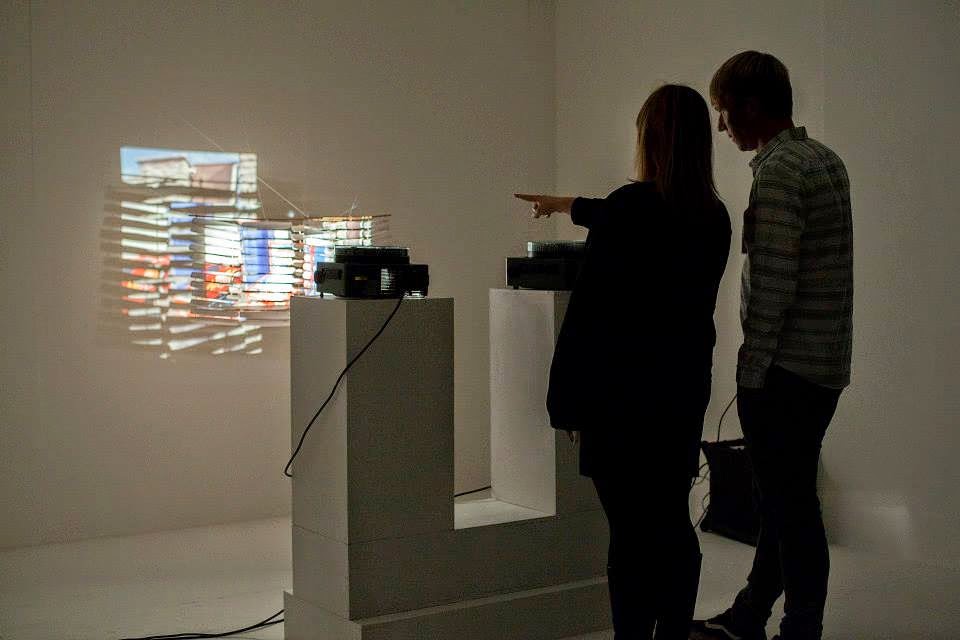
(edge of representation) is a new time-based installation piece I completed for the Bournemouth Emerging Arts Fringe as part of this years Arts by the Sea Festival. The work, which was shown at LUNG gallery on the 1st October, explores the conflict between systems of ordering and control, which Henri Lefebvre describes as ‘representations of space’, and visual representations of Bournemouth as ‘representational spaces’. 'Representations of space' are described as the maps, plans and strategies of urban planners and social engineers for controlling the way spaces are used and the people who use them, while ‘representational spaces’ are partly imagined, exist in the realm of the symbolic, and can represent of our hopes, dreams and identities. The work also seeks to embody the paradox of commercialised leisure: that however hard we try to escape the constraints of society and self, and predictability of everyday life, our attempts will always be thwarted by the organising systems and taken-for-granted typifications, which structure that which Zygmunt Bauman terms our 'life-world'; leaving us feeling disappointed and trapped. Moreover, the sense of subjective freedom we attain through everyday escape attempts, encompassing our ability to re-imagine and transform our surroundings, are also under threat from the tendancy to make our visual and discursive representations fall in line with a concensus or that which sociologist Erving Goffman refers to as ‘paramount reality'.
The piece is centred on two automated 35mm slide carousel projectors, set slightly out of synch to suggest a clash or conflict of ideologies. One carousel contains images of systems of ordering and control – diversionary entertainments, maps, signs and information boards, CCTV cameras and penalty warnings – and on the other houses visual representations of Bournemouth as a heterotopia of touristic possibilities – moments of heightened aestheticisation and improvised narratives in the visual vernacular of Continental tourist travel. The first set of images (utilitarian), are taken using Fuji film and have a slightly cold, detached feel, and the second (romantic) are shot in Kodak to give them a nostalgic glow. The de-synchonisation of the carousels leads to a new set of image combinations after each full rotation. This lends the work the element of chance as the sequence works its way through all potential variables of image juxtaposition. This is a direct reference to the carnivaleque strategy of chance as means of eliminating the sense of boredom, pre-determination and fate experienced in everyday life. The use of outmoded analog equipment with its mechanical action, together with these chance juxtapositions, also suggest both the fragility of life and the vulnerability of the meaning in the autobiographical images we store in the image magazines in our minds (our own machines of representation). These meanings are also enriched by the use of screens made from razor shells: the discarded husks of lives once lived. The work is backed by a specially commissioned soundtrack, made in collaboration with Bournemouth hauntological music duo Language Timothy! This uses stereophonic sound design to produce a sense of location: both inducing feelings of disorientation and augmenting the dualistic visual onslaught with a immersive sound-scape to overwhelm the senses. The soundtrack is comprised of field recordings from a local amusement arcade, together with a range of samples, including a 1950s instrumental version of Stranger in Paradise; a title which is perhaps the best metaphor for the tourist paradox.